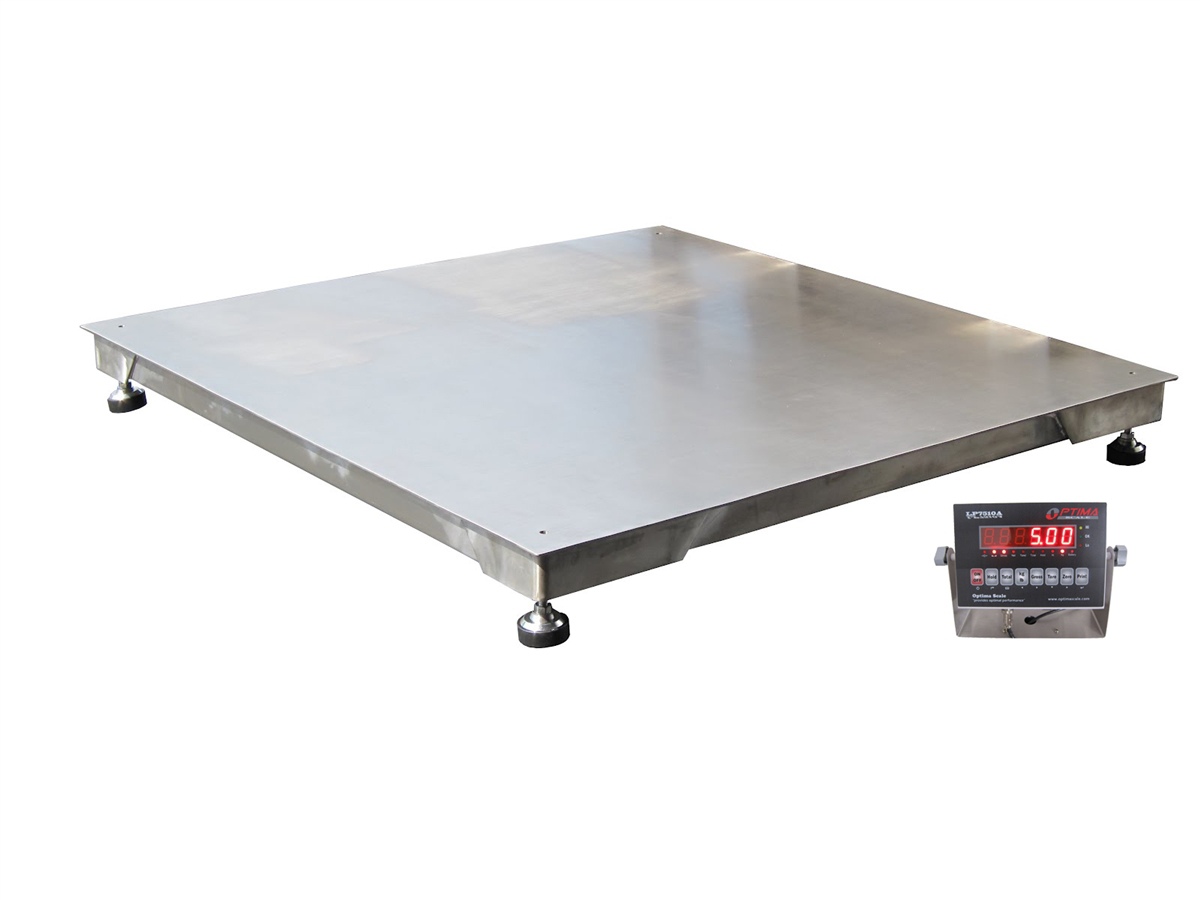
Measuring heavy steel plates requires a specific class of floor scale designed for concentrated point loads and high-impact resistance. Steel plates are often thin but extremely dense, which can "dimple" or bend standard-duty platforms.
In 2026, the industry standard for steel plate weighing is a reinforced mild steel platform with a high "end-load" capacity rating.
1. Top-Rated Models for Steel Weighing
These models are specifically engineered for the high-impact, high-density environment of steel fabrication and stockholding.
- Rice Lake RoughDeck® HP-H:
- The Build: Features a structural steel channel frame (6-inch) that prevents deck deflection.
- Capacity: Up to 15,000kg (15 Tons).
- Best Feature: Backed by a 5-year structural warranty, making it one of the most robust options globally for 2026.
- Mettler Toledo VFS Series:
- The Build: Available in large formats (up to $2\text{m} \times 2\text{m}$) with a "Rocker Pin" suspension system that ensures accurate weighing even if the plate is dropped slightly off-center.
- Connectivity: Integrated with PowerCell technology to alert you if a load cell is struggling under an uneven plate load.
- SiGMA LP7510 Heavy Duty:
- The Build: Uses a 5mm to 6mm thick checkered top plate with wide beam internal reinforcement.
- Capacity: Ranges from 5 Tons to 30 Tons (customizable).
- Value: Often cited as the best "price-to-performance" ratio for 2026 industrial sales.
2. Crucial Specifications for Steel Plates
When measuring steel plates, do not look at just the total capacity. Check these three "Robustness Indicators":
|
Specification |
Requirement for Steel Plates |
Why it Matters |
|
End Load Capacity |
100% or higher |
Steel plates are often loaded on one edge first; the scale must handle the full weight on just two load cells. |
|
Deck Thickness |
Minimum 5mm ($1/4"$) |
Prevents "dimpling" from corners of plates or heavy metal bins. |
|
Platform Finish |
Checkered / Diamond Plate |
Prevents large plates from sliding during loading, which can shear the load cell bolts. |
3. Size Recommendations for Plate Stock
- Standard Sheets ($1.2\text{m} \times 2.4\text{m}$): You should look for a $1.5\text{m} \times 1.5\text{m}$ platform. While the plate will "overhang," these robust scales are designed to calculate the weight accurately as long as the center of gravity is over the platform.
- Large Structural Plates: A $2\text{m} \times 2\text{m}$ platform is the safest for avoiding "plate-tip" when using a forklift.
4. 2026 Price Estimates (Heavy Duty)
- Standard (3-Ton, $1.2\text{m} \times 1.2\text{m}$): $850 – $1,500
- Heavy Duty (5-Ton, $1.5\text{m} \times 1.5\text{m}$): $1,800 – $2,800
- Industrial Grade (10-Ton+, $2\text{m} \times 2\text{m}$): $3,500 – $6,000
5. Installation Tip: Pit vs. Surface
For steel plates, Pit-Mounted (flush with the floor) is highly recommended.
- Safety: It removes the trip hazard of the plate edge.
- Protection: It prevents forklifts from accidentally hitting the side of the scale (the most common cause of load cell failure).