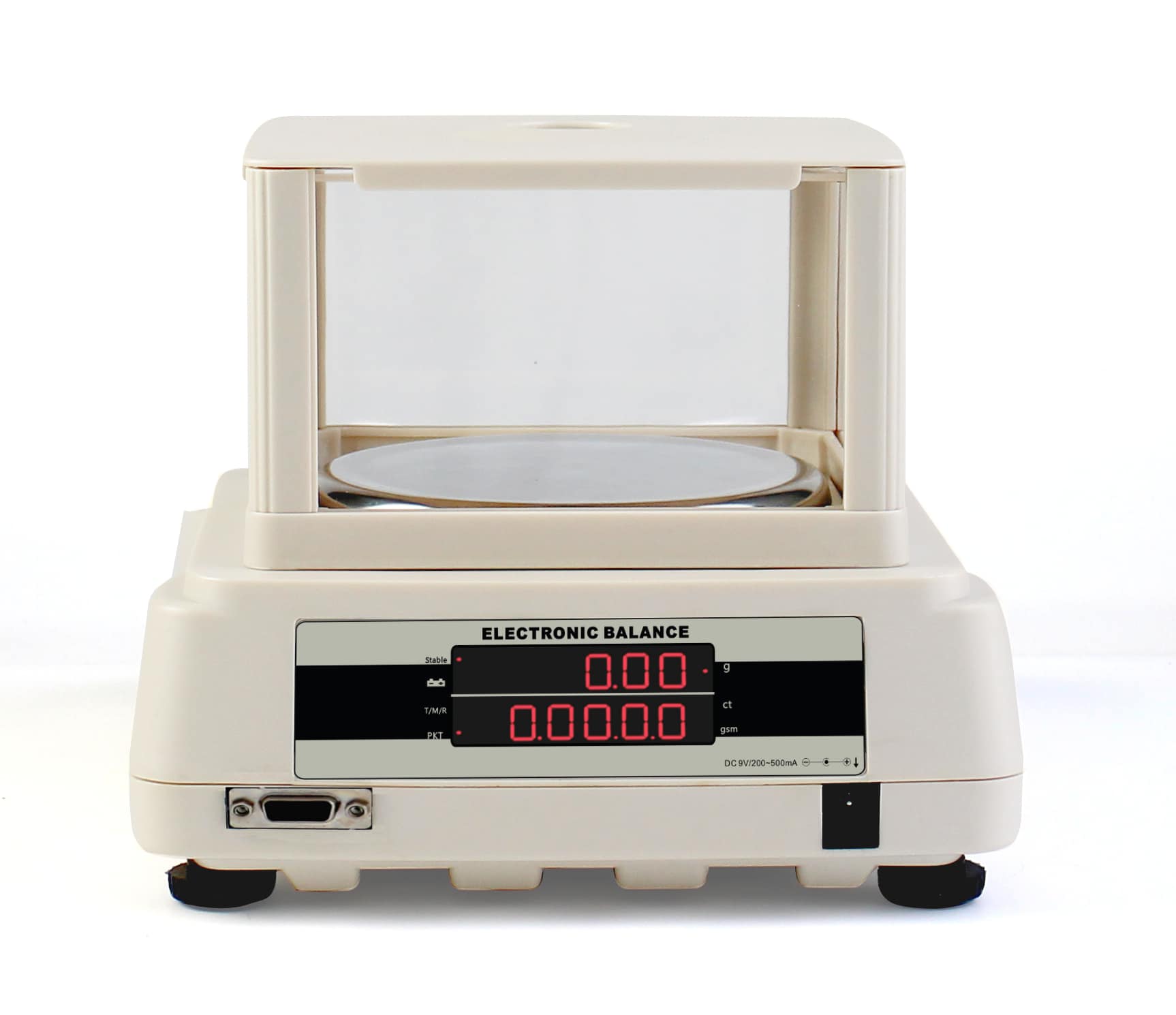
the process of taking initial and final readings is technically known as Differential Weighing or Backweighing.
Modern digital analytical balances now feature dedicated software (like the Sartorius Backweighing App or Mettler Toledo Differential Weighing) that eliminates the need for manual pen-and-paper subtraction. The balance stores the "Initial" weight in its internal memory and automatically subtracts the "Final" weight to display the net difference.
1. Top 2026 Balances with Built-in "Initial/Final" Apps
|
Model |
Application Name |
Best Feature for Differential Weighing |
|
Sartorius Cubis II |
Backweighing QApp |
Allows "Lot Tracking" and up to 100 sample IDs in a single run. |
|
Mettler Toledo MR |
Differential Weighing |
Guided workflow on the touchscreen; flags errors if samples are mixed up. |
|
Ohaus Explorer |
Differential Application |
Large 7" screen shows Initial, Final, and Result simultaneously. |
|
A&D Apollo |
Statistical Calculation |
Can calculate the mean and standard deviation of multiple initial/final runs. |
2. Common Workflows for Initial & Final Readings
A. The "Backweighing" Method (Loss on Drying)
Common in moisture analysis or ash content testing.
- Initial: Weigh the empty crucible + wet sample. (The balance stores this as $W_1$).
- Processing: Remove the sample and dry it in an oven.
- Final: Place the dried sample back on the balance.
- Result: The balance automatically calculates $W_1 - W_2$ and displays the % Loss or Mass Difference.
B. The "Weighing by Difference" Method (Direct Transfer)
Common in chemistry when transferring a precise amount of powder to a flask.
- Initial: Weigh the full weighing bottle. (Store as $W_{\text{start}}$).
- Transfer: Pour a portion of the powder into your flask.
- Final: Re-weigh the now lighter weighing bottle. (Store as $W_{\text{end}}$).
- Result: The balance displays the exact mass transferred ($W_{\text{start}} - W_{\text{end}}$).
3. Advanced 2026 Features for Accuracy
- Sample ID Matching: You can use a barcode scanner connected to the balance. Scan the vial for the "Initial" reading, and when you scan it again later for the "Final" reading, the balance automatically retrieves the correct initial data from its database.
- Automatic Stability Recognition: The balance will only record the "Initial" reading once the weight has settled for at least 1.5 seconds, preventing "operator rush" errors.
- Data Integrity (Audit Trail): In regulated pharma labs, the balance creates a PDF report that shows exactly who took the initial and final readings, at what time, and what the room temperature was.
4. Setup Tips for Success
The Thermal Equilibrium Rule: When taking a "Final" reading after heating a sample (like in an oven), you must allow the crucible to cool to room temperature in a desiccator. If the sample is even $5^\circ\text{C}$ warmer than the balance chamber, air currents (buoyancy) will make the "Final" reading lighter than it actually is.
The Container Rule: Always use the same container for the initial and final steps. Even identical-looking glass vials can vary by $20\text{mg}–50\text{mg}$, which is a massive error for a $0.1\text{mg}$ analytical balance.