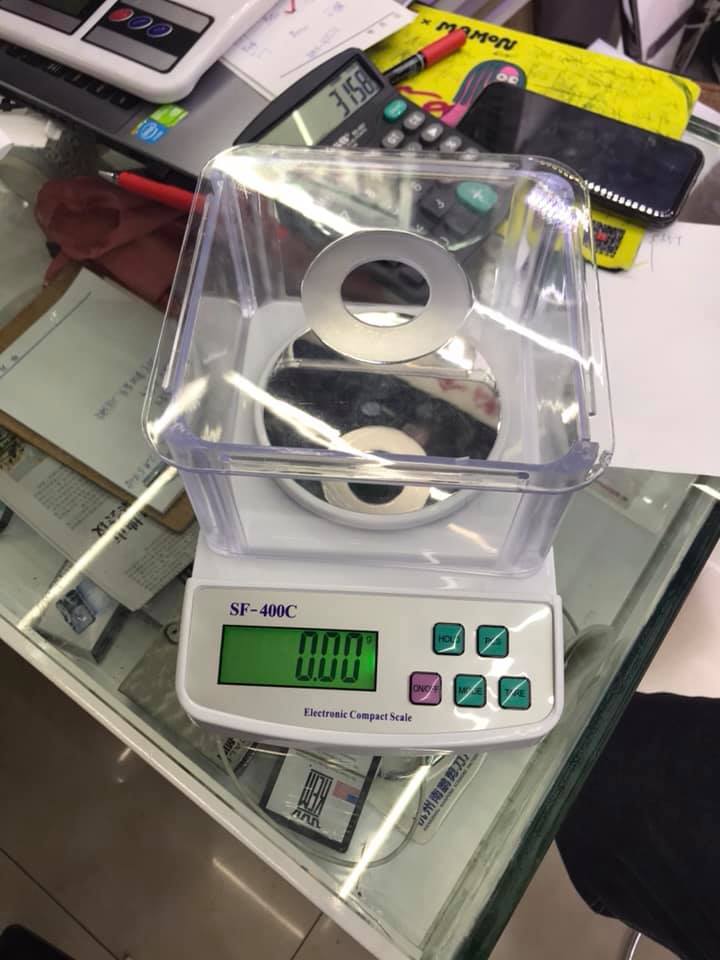
balance with $0.001\text{g}$ ($1\text{mg}$) readability is technically classified as a Precision Balance (whereas true "Analytical Balances" typically reach $0.0001\text{g}$).
These milligram scales are the "workhorses" of the lab, balancing high sensitivity with a higher weight capacity than four-decimal models.
1. Top Recommended $0.001\text{g}$ Balances (2026)
|
Model |
Capacity |
Calibration |
Typical 2026 Price |
Best For |
|
Sartorius Entris II |
Up to $620\text{g}$ |
Internal (isoCAL) |
$1,800 – $2,400 |
The Professional Standard: Reliable German engineering for R&D. |
|
Mettler Toledo ME |
Up to $420\text{g}$ |
Internal |
$1,500 – $2,100 |
Pharma-Grade Entry: Robust metal base with long-term stability. |
|
Kern 572-30 |
$240\text{g}$ |
External |
$450 – $600 |
Industrial Quality: All-metal housing, very rugged for field use. |
|
U.S. Solid DBS46 |
$210\text{g}$ |
External |
$100 – $180 |
Budget Choice: Great for schools, jewelers, or hobbyist labs. |
|
Vevor Analytical |
$500\text{g}$ |
External |
$140 – $160 |
High Capacity: Large capacity at a low cost; backlit LCD. |
2. Key Technical Features
- Draft Shield (Windshield): Essential for $0.001\text{g}$ precision. Even a slight breeze from an AC vent can push on the pan with more than $1\text{mg}$ of force.
- Internal vs. External Calibration:
- Internal: The balance has a built-in motor and weights. It calibrates itself automatically when it detects a temperature change.
- External: You must manually place a certified $100\text{g}$ or $200\text{g}$ weight on the pan to calibrate it.
- Stabilization Time: Modern 2026 models (like the Sartorius Entris II) stabilize in under 1.5 seconds, while budget models may take 3–5 seconds.
- Connectivity: Professional models feature USB-C or RS232 for direct data transfer to Excel or lab software (LIMS).
3. Critical Setup Requirements
The Warm-Up Rule: To achieve $0.001\text{g}$ accuracy, a precision balance must be plugged in and "warmed up" for at least 30 minutes to stabilize its internal electronics.
Leveling: Look for the integrated bubble level. If the scale is even slightly tilted, the force of gravity won't be perpendicular to the sensor, leading to linear errors.
4. 2026 Price Breakdown
- Academic/Hobbyist ($100 – $300): These use strain gauge sensors. They are affordable but can "drift" if the room temperature changes quickly.
- Professional Laboratory ($1,200 – $2,500): These use Electromagnetic Force Restoration (EMFR) technology. They are much more stable and can stay calibrated for months.