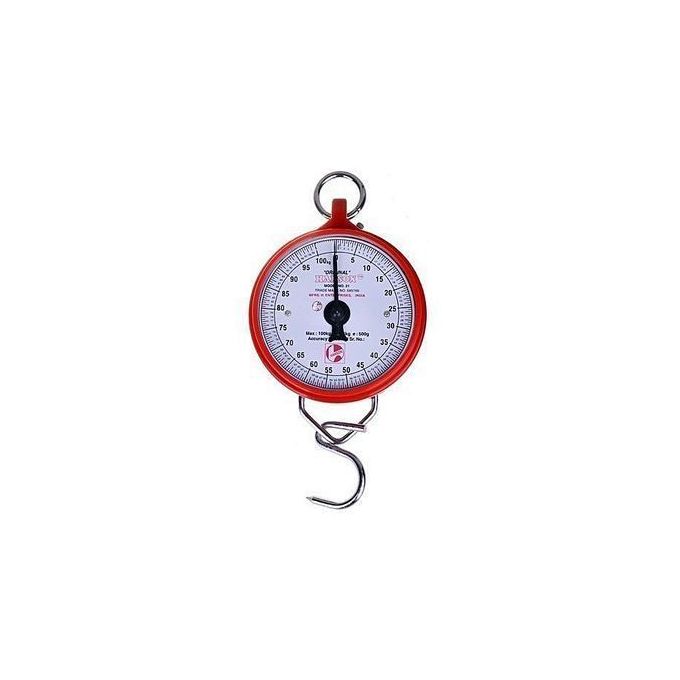
A Mechanical Crane Scale (also known as a Dial Crane Scale or Spring Hanging Scale) with metallic steel hooks is a non‑electronic hanging weighing instrument that measures suspended loads using a spring/lever mechanism and displays the weight on a large analog dial. These are rugged, reliable scales ideal for industrial, workshop, warehouse, agricultural, and commercial weighing needs where electronic power isn’t required.
🛠️ Key Characteristics
⚖️ Mechanical Weighing System
- Weighing Mechanism: Spring or lever‑based mechanical load measurement.
- Display: Large analog dial with clear graduations (kg/lb) — no electronic display or batteries required.
- Designed for simple, reliable operation with immediate reading when load is suspended. (globalweighscales.com)
📎 Construction & Materials
🔩 Metallic Steel Hooks
- Heavy‑duty steel hooks on both top (suspension) and bottom (load) for secure attachment.
- Hooks fitted with safety latches to prevent accidental un‑hooking during weighing.
- Built from high‑strength alloy steel to sustain repeated load applications.
- Corrosion‑resistant finish ensures longevity in workshop and industrial environments. (weighingengineering.co.uk)
🏗️ Scale Body
- All‑metal construction: Durable steel frame and housing for rugged industrial use.
- Reinforced internal spring/lever calibrated for repeated heavy loads.
- Protective impact‑resistant coating/paint on body for long service life.
📏 Typical Specifications
|
Specification |
Value / Feature |
|
Scale Type |
Mechanical Hanging Crane Scale (Dial Type) |
|
Display |
Large analog dial (kg / lb scale) |
|
Hook Material |
Heavy‑duty steel with safety latch |
|
Body Material |
Alloy steel / metal housing |
|
Capacity Range |
50 kg – 500 kg (common); some industrial versions up to 1000 kg |
|
Accuracy |
±1–2% of full scale (typical for mechanical types) |
|
Graduation Marks |
Dual kg/lb graduations on dial plate |
|
Operation |
Fully mechanical — no batteries or electronics |
|
Portability |
Lightweight, easy to install/remove |
|
Temperature Compatibility |
Workable in typical ambient conditions |
🏋️ Load Capacities
Common mechanical crane scale ranges include:
✔ 50 kg — light duty, home, small workshop weighing
✔ 100 kg — light industrial use
✔ 200 kg – 300 kg — warehouse and commercial loads
✔ 500 kg — heavier industrial materials
✔ Up to 1000 kg — specialized heavy mechanical dial models (less common)
Exact capacity graduations depend on specific model and manufacturer configuration.
🧰 Weighing Considerations
📏 Analog Dial Reading
- The scale’s dial features graduated markings in kg and lb, allowing quick, instant reading without electrical components.
- A pointer/needle moves in proportion to load force — perfect for quick checks or settings where digital scales aren’t practical.
⚠️ No Power Requirement
- Mechanical scales work without electricity or batteries, making them ideal for remote, field, or rugged environments with no power access.
👩🔧 Maintenance
- Occasional hook lubrication and spring calibration ensure continued accuracy.
- Lightweight build means less to go “out of calibration” compared with electrical load cells.
🏭 Applications
Mechanical crane scales with steel hooks are commonly used for:
✔ Workshops & Fabrication Shops — quick load checks on materials and parts
✔ Warehouses & Storage Yards — weighing sacks, parcels, crates
✔ Agriculture & Produce Markets — weighing agricultural products
✔ Construction Sites — measuring heavy building materials
✔ Scrap & Recycling Yards — bulk material weight estimation
✔ Home & Portable Use — weighing medium loads without electricity
💡 Advantages of Mechanical Crane Scales
- No electrical power needed — always ready to use.
- Durable, all‑metal build — ideal for rugged environments.
- Low cost & low maintenance.
- Immediate analog readings — visible at a glance.
- Reliable and simple operation for basic weighing tasks.
📌 Limitations Compared to Digital Scales
While rugged and reliable, mechanical scales typically have:
❗ Lower accuracy (±1–2% vs ±0.1% common for digital).
❗ No digital interface (no electronic functions like tare, unit switch, memory).
❗ Larger dial size for the same load capacity.
Mechanical scales excel where simplicity, ruggedness, and no‑power reliability are priorities.