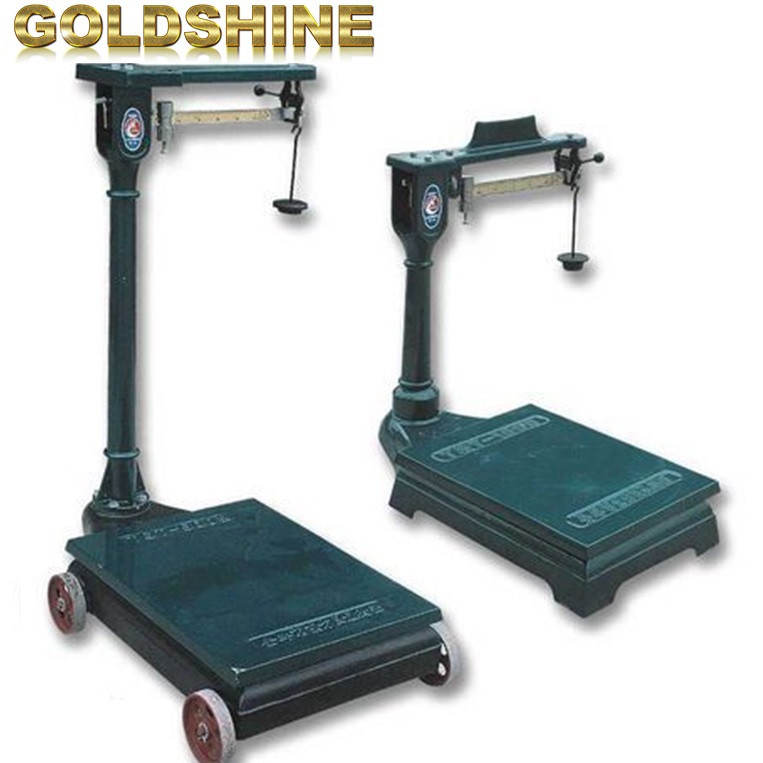
manual-dial heavy-duty platform scales remain a vital industrial tool for sectors that prioritize instant visual feedback and total independence from power sources. While the "steelyard" (sliding poise) scale is best for high-capacity bulk weighing, the dial type is preferred for speed and ease of reading in high-volume environments.
1. How They Work: The Spring & Lever System
Unlike digital scales that use electronic pulses, manual dial scales use a physical spring and lever mechanism:
- The Loading: When an object is placed on the platform, its weight pushes down on a series of interconnected levers.
- The Resistance: This force is resisted by a calibrated high-tension spring.
- The Display: The compression or expansion of the spring is mechanically translated to the rotation of a needle (pointer) across a large, fixed dial.
2. Technical Specifications (2026 Standards)
|
Feature |
Heavy-Duty Standard |
|
Capacity |
Commonly $50\text{kg}, 100\text{kg}, 150\text{kg}, \text{ and } 500\text{kg}$ |
|
Accuracy |
$\pm 0.5\%$ to $1\%$ (typically $200\text{g} - 1000\text{g}$ increments) |
|
Platform Material |
Reinforced Cast Iron or Stainless Steel (for food/wet use) |
|
Dial Readout |
Dual Unit (kg and lbs) with a high-contrast red pointer |
|
Ingress Protection |
Often IP65 equivalent (shatterproof lens, rust-resistant body) |
3. Why Choose "Manual Dial" over Digital or Steelyard?
- Instant Response: The needle moves in real-time as you add or remove items. Digital scales often have a 1-2 second "settling" delay.
- No Parallax Features: 2026 premium models (like HiWEIGH or Detecto) feature "Double-Dial" designs or angled displays to reduce parallax error (where the reading changes depending on your viewing angle).
- Zero Downtime: No batteries to charge and no motherboards to fail. They are "Always On."
- Vibration Tolerance: Dial scales are often better at weighing items on vibrating floors (near heavy machinery) where digital sensors might "flicker" between numbers.
4. Top Models for 2026
- HiWEIGH TZ Series: A "Rugged Double-Dial" favorite for warehouses. It includes heavy-duty cast-iron wheels and a reinforced frame for up to $500\text{kg}$ loads.
- Tada Heavy Duty: Known for its $150\text{kg}$ stainless steel platform models. It is a staple in commercial kitchens and meat processing plants due to its ease of sanitization.
- Detecto PT Series: High-end, American-engineered dial scales that are used extensively in postal and shipping hubs for their accuracy and "overload-proof" spring systems.
5. Maintenance: The "Spring Fatigue" Factor
While dial scales are incredibly robust, they are subject to spring fatigue over years of heavy use.
- Zeroing: Every 2026 dial scale has a zero-adjustment knob (usually under the platform or on top of the dial). You must check this daily to ensure the needle sits exactly on "0" before weighing.
- Shock Loading: Avoid dropping heavy items onto the platform. A sudden "shock" can stretch the internal spring, permanently ruining the scale's calibration.


