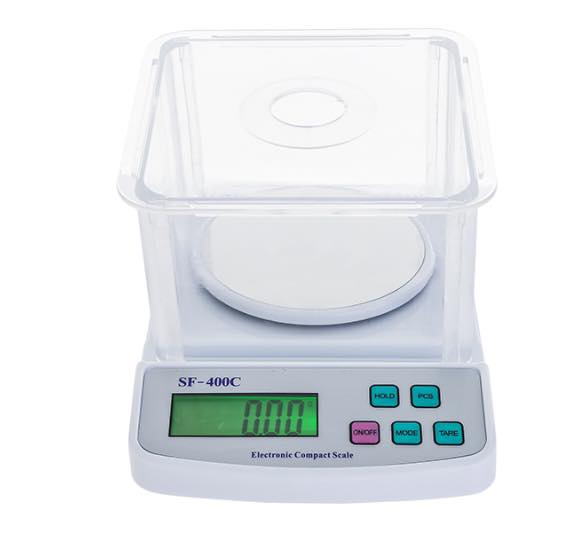
"Verified for Trade" (also known as "Legal for Trade") balance is legally required if you are selling products by weight—such as in a compounding pharmacy, jewelry store, or legal cannabis dispensary. These balances undergo rigorous testing and are "sealed" by weights and measures authorities to ensure fair transactions.
+1
1. How to Identify a Verified for Trade Balance
High-precision "Trade" balances are usually categorized as Class II (for fine laboratory/jewelry use) or Class I (for high-end analytical use). Look for these indicators:
- The "M" Mark: In many regions, you will see a Green "M" or a Black "M" on the serial plate.
- NTEP Certificate (USA): Look for an NTEP Certificate of Conformance (CoC). This is a 100% requirement in the United States for commercial weighing.
+1
- OIML Approval (International): For Europe and most other countries, look for OIML R76 compliance and Class II markings ($(\text{II})$).
- The Physical Seal: These units have a lead seal or a tamper-evident sticker. If this seal is broken, the scale's "Verified" status is void until a certified inspector re-stamps it.
+1
2. Top "Legal for Trade" Precision Balances (2026)
|
Model |
Class |
Readability (d) |
Verification (e) |
Typical 2026 Price |
|
Sartorius Entris II (NTEP) |
II |
$0.001\text{ g}$ |
$0.01\text{ g}$ |
$1,800 – $2,400 |
|
A&D FX-300iN |
II |
$0.001\text{ g}$ |
$0.01\text{ g}$ |
$1,400 – $1,750 |
|
Ohaus Pioneer PX423N |
II |
$0.001\text{ g}$ |
$0.01\text{ g}$ |
$1,200 – $1,600 |
|
A&D Everest EK-600i |
II |
$0.1\text{ g}$ |
$0.1\text{ g}$ |
$450 – $600 |
|
Adam Highland HCB-M |
II |
$0.01\text{ g}$ |
$0.1\text{ g}$ |
$700 – $950 |
3. Understanding $d$ vs. $e$
On a verified balance, you will see two different readability specs:
- Readability ($d$): This is the smallest increment the scale can physically show (e.g., $0.001\text{ g}$).
- Verification Scale Interval ($e$): This is the increment used for legal billing.
Note: For many Class II balances, the legal billing interval ($e$) is 10 times larger than the actual display ($d$). For example, a scale that displays $0.001\text{ g}$ might only be "Verified" to charge customers in $0.01\text{ g}$ increments.
4. Key 2026 Technologies for Trade
- Internal Calibration (isoCAL): Verified scales must maintain accuracy. Modern units like the Sartorius Entris II have built-in weights that automatically adjust the balance if the room temperature changes by even 1.5°C.
- Audit Trails: Digital legal-for-trade scales now keep an internal "event log." If anyone attempts to change the calibration or settings, the scale records the date, time, and user ID for inspectors to see.
- Secure Connectivity: To prevent tampering with prices or weights, modern trade balances often use encrypted USB or Wi-Fi to send data directly to Point of Sale (POS) systems.
5. Important Buying Advice
Check Local Rules: In 2026, some states and countries require that a local inspector visits your business to "place the scale into service" even after you buy a certified model.
Gravity Compensation: Because gravity varies slightly by location, "Legal for Trade" balances are often calibrated for a specific latitude and longitude. If you buy a verified scale and move it to a different city, you may need a certified technician to re-verify it.