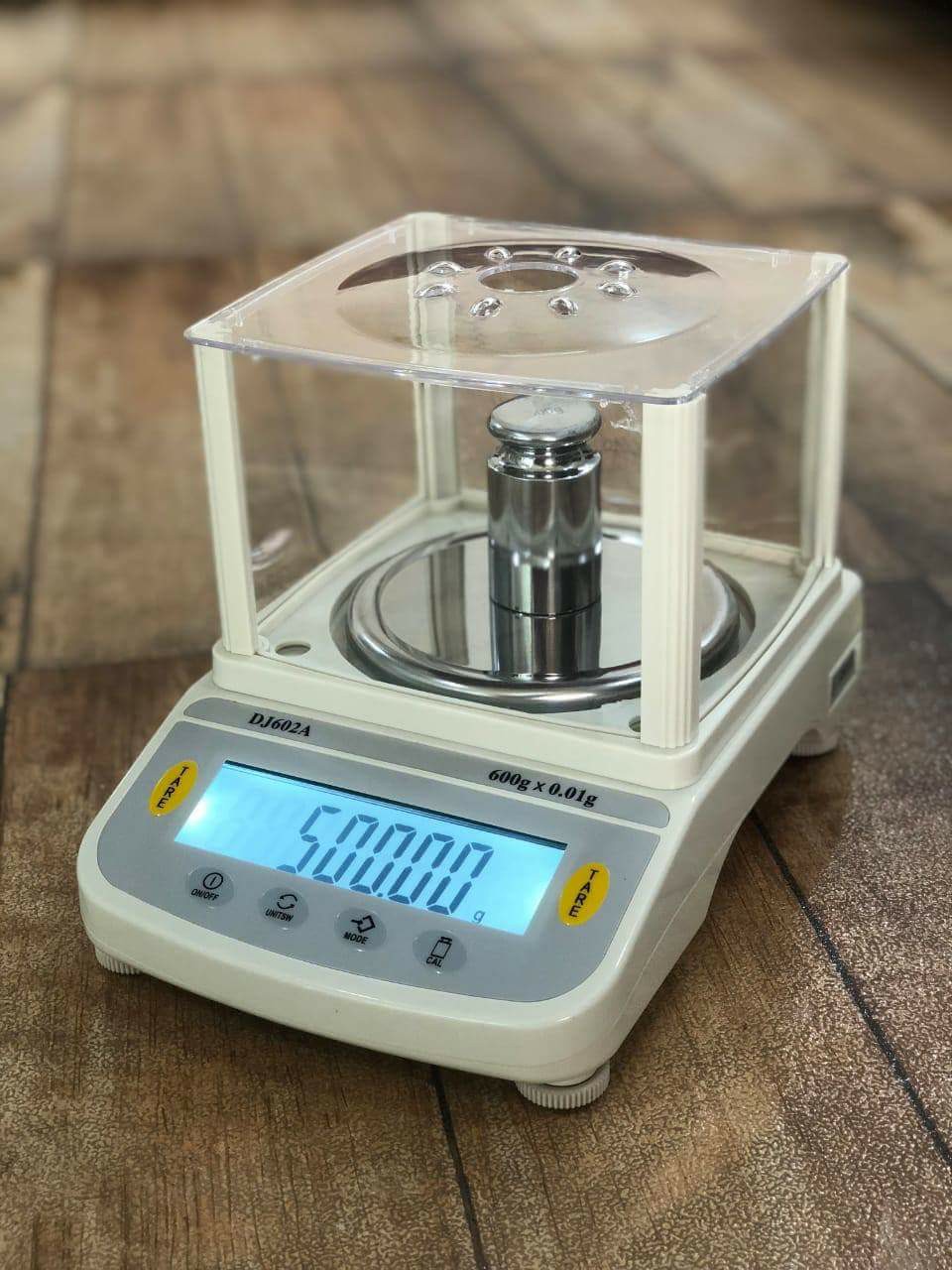
High Precision Analytical Balance is specifically engineered for Mass Determination with a readability of $0.1\text{ mg}$ ($0.0001\text{ g}$) or finer. These instruments differ from standard scales by using Electromagnetic Force Restoration (EMFR) technology rather than simple springs or strain gauges, allowing them to detect the weight of a single grain of fine sugar or a short human hair.
1. 2026 Market Leader Comparison
|
Tier |
Best Model |
Typical Price |
Key Mass Advantage |
|
Pharma Grade |
Sartorius Cubis II |
$10,000 – $25,000+ |
Total Integrity: Fully modular; meets 21 CFR Part 11 for traceable mass data. |
|
R&D Workhorse |
Mettler Toledo MR |
$3,800 – $9,500 |
Stability: "SmartPan" reduces air turbulence errors by 50% for faster mass readings. |
|
Environmental |
A&D Apollo GX-AE |
$3,500 – $6,000 |
Static Control: Built-in fanless ionizer neutralizes charges that "push" on the mass sensor. |
|
Budget Lab |
Ohaus Pioneer PX |
$1,000 – $3,800 |
Durability: Cast metal lower housing provides a rigid base for consistent mass results. |
2. Critical Metrics for Mass Accuracy
- Readability ($d$): The smallest difference in mass the balance can display ($0.1\text{ mg}$ for analytical).
- Repeatability: The balance's ability to display the exact same mass when the same object is weighed multiple times (typically $\pm 0.1\text{ mg}$).
- Linearity: Accuracy across the entire range; a 100g weight should be as accurate as a 10mg weight (typically $\pm 0.2\text{ mg}$).
- Minimum Weight: The smallest amount of mass you can weigh while staying within your lab's allowed "uncertainty" (e.g., USP standards might require at least $20\text{ mg}$ of sample for a $0.1\text{ mg}$ balance).
3. Advanced 2026 "Mass" Features
- Automatic Internal Calibration (FACT/isoCAL): The balance uses an internal mass standard to recalibrate itself if the room temperature shifts by even $1.5^\circ\text{C}$.
- Impact Shock Detection (ISD): New for 2026 in models like the A&D Apollo, this detects if the weighing cell was physically bumped, which could compromise the accuracy of your mass readings.
- Auto-Leveling: High-end models (Sartorius Quintix Pro) now have motorized feet that level the balance automatically. If the balance isn't level, gravity doesn't hit the sensor straight, causing "cosine errors" in mass measurement.
4. Pro Tip: The "Draft Shield" Rule
Because $0.1\text{ mg}$ is such a small mass, even the heat from your hand or a nearby air vent will cause the display to drift. In 2026, professional analytical balances always include a glass draft shield. For the most accurate mass determination, you should keep the doors closed for at least 5 seconds before recording the weight.