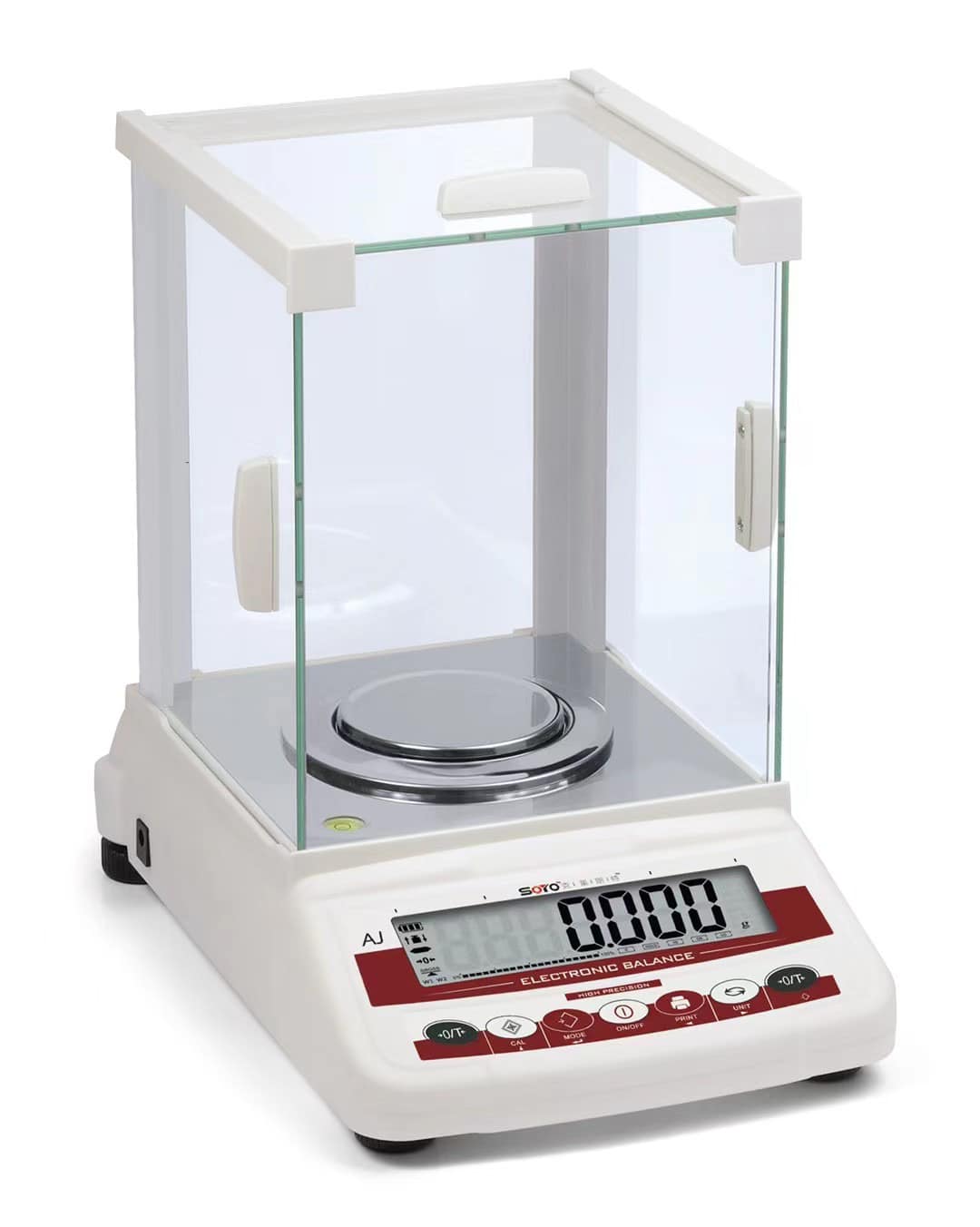
analytical precision laboratory balances with touchscreen interfaces have become the industry standard for research, pharmaceutical, and high-end industrial labs. These balances typically offer a readability of $0.1\text{ mg}$ ($0.0001\text{ g}$) or better and feature high-resolution displays that mimic smartphone functionality for easier data management.
1. Top Recommended Touchscreen Models (2026)
|
Model |
Readability |
Touchscreen |
Key Advantage |
|
Sartorius Cubis II |
Up to $0.01\text{ $\mu$g}$ |
7" Color |
Pharma Grade: Modular design with full 21 CFR Part 11 compliance. |
|
Mettler Toledo MR |
$0.01\text{ mg}$ – $1\text{ g}$ |
4.5" TFT |
The Workhorse: Robust housing with smart connectivity for high throughput. |
|
Sartorius Quintix Pro |
$0.01\text{ mg}$+ |
7" Graphic |
User Experience: Motorized leveling and "isoCAL" automatic calibration. |
|
Ohaus Explorer |
$0.1\text{ mg}$ |
7" VGA |
Feature Rich: SmarText 2.0 software with 14 application modes. |
|
A&D Apollo GX-AE |
$0.1\text{ mg}$ |
High-Res LCD |
Static Control: Built-in fanless ionizer to neutralize charges in < 1 second. |
2. Benefits of Touchscreen Interfaces
- Intuitive Workflows: Step-by-step "wizards" guide users through complex tasks like density determination, formulation, and pipette calibration.
- Customizable Dashboards: You can pin frequently used applications (e.g., "Parts Counting" or "Percent Weighing") to the home screen for one-touch access.
- Data Integrity: Modern touchscreens support user profiles with password protection, ensuring that only authorized personnel can change settings or delete results.
- Connectivity: Touch interfaces in 2026 often include a "driverless" HID connection, allowing you to send data to a PC or LIMS (Lab Information Management System) without additional software.
3. Critical Technical Features
- Internal Calibration (isoCAL/FACT): High-precision balances use internal weights to self-calibrate automatically when they detect a change in ambient temperature. This ensures your $0.1\text{ mg}$ reading remains accurate throughout the day.
- Motorized Leveling: Some premium models (like the Sartorius Quintix Pro) feature sensors that detect if the balance is tilted and automatically adjust the feet to level the unit—a critical step for precision.
- Static Management: Static electricity is the #1 enemy of analytical weighing. Models with integrated ionizers (like the A&D Apollo) are essential if you are weighing fine powders or working in low-humidity environments.
- Draft Shield Design: Look for "ErgoDoors" or automatic doors that can be programmed to open via a gesture sensor, reducing the risk of contaminating the weighing chamber.
4. Setup for Maximum Precision
The Granite Rule: For $0.1\text{ mg}$ precision, the balance must be placed on a heavy stone anti-vibration table. Even a person walking nearby or a nearby centrifuge can cause the last digit of the display to "drift" or flicker.
Acclimatization: When first plugged in, an analytical balance needs roughly 30–60 minutes to warm up its internal electronics before it can provide its most stable readings.