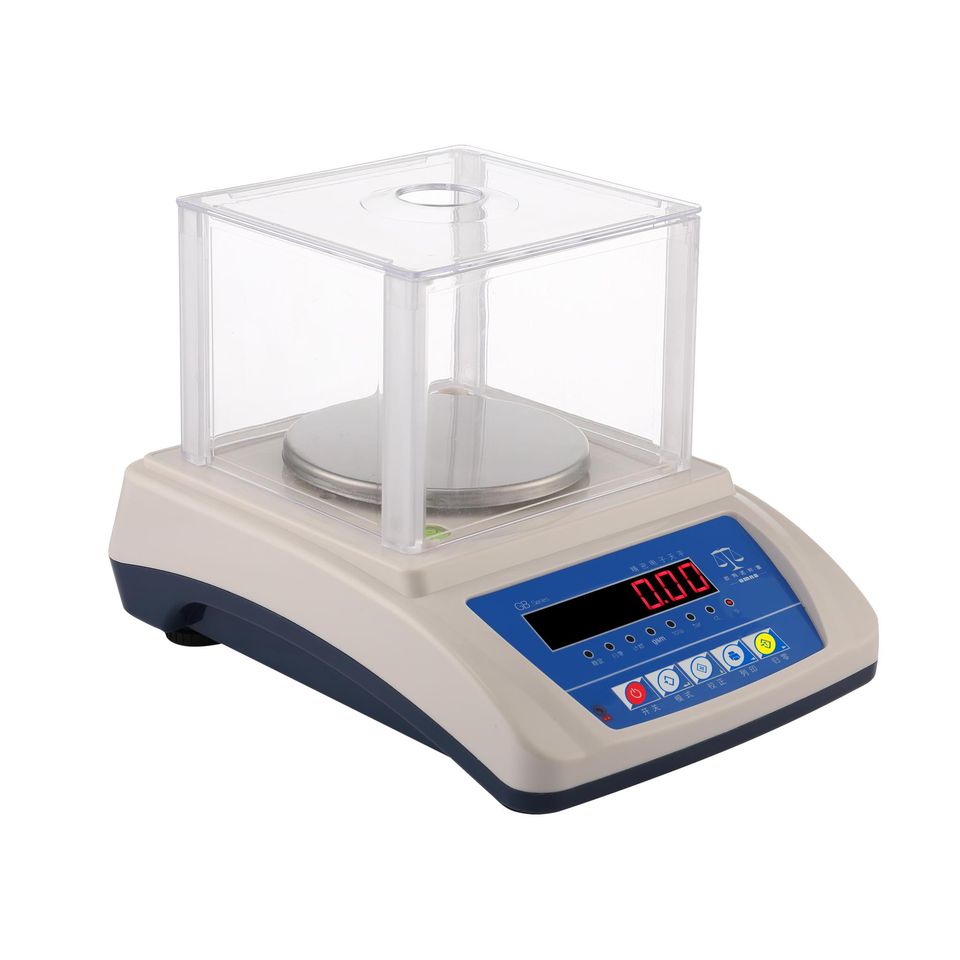
Normal Measurement" function of an analytical balance refers to the standard, high-precision weighing mode used for day-to-day laboratory tasks. While simple in concept, it involves a specific sequence of operations to ensure the $0.0001\text{g}$ (or finer) readability remains accurate and unaffected by the environment.
1. The Standard Weighing Workflow
The "normal" function follows a standardized procedure to eliminate variables:
- Warm-up: The balance must be plugged in for 30–60 minutes to reach "thermal equilibrium."
- Zeroing: With the pan empty and doors closed, the "Zero" button is pressed to set the baseline.
- Taring: A container (weigh boat or flask) is placed on the pan. The "Tare" button is pressed to subtract the container's mass, so the display returns to $0.0000\text{g}$.
+1
- Loading: The sample is added (ideally while the pan is removed or very carefully through the side doors).
- Stabilization: The glass doors are closed. You must wait for the stability indicator (usually an asterisk or a checkmark) to appear before recording the result.
2. Common Application Modes (The "Expanded Normal")
Most 2026 analytical balances include several "normal" sub-functions built into the software:
|
Function |
What it Does |
Common Use |
|
Simple Weighing |
Standard mass determination in grams, milligrams, etc. |
Basic reagent measurement. |
|
Parts Counting |
Calculates the number of items based on a "Reference Weight" of one piece. |
Counting tiny electronic components or pills. |
|
Percentage Weighing |
Displays the weight as a percentage of a target "100%" sample. |
Comparing sample loss or gain during a reaction. |
|
Density Determination |
Uses a density kit (buoyancy) to calculate solid or liquid density. |
Materials science and quality control. |
|
Statistics |
Automatically calculates the Mean, Standard Deviation, and Min/Max for a series. |
Batch testing and quality assurance. |
3. Factors That "Normal" Measurements Must Correct
Analytical balances are so sensitive ($0.1\text{mg}$ is roughly the weight of a single grain of sugar) that they are actually measuring the force of gravity on the mass. "Normal" measurement can be skewed by:
- Buoyancy: Air pushes up on the sample. If the sample is warmer than the chamber, it creates a "mini-updraft" that makes the sample appear lighter.
- Static: Plastic weigh boats carry a charge that "pulls" the pan toward the draft shield. In 2026, many balances include a "StaticDetect" function to alert you to this.
- Evaporation: If weighing a liquid, the reading will "drift" downward as the liquid turns to vapor.
4. When to Use "Normal" vs. "Specialized"
- Use Normal/Simple: When you just need a weight to record in a notebook.
- Use Differential (Backweighing): If you are weighing a sample before and after it goes into an oven (Initial vs. Final).
- Use Dynamic: If the sample is moving (e.g., a live insect or a vibrating liquid).