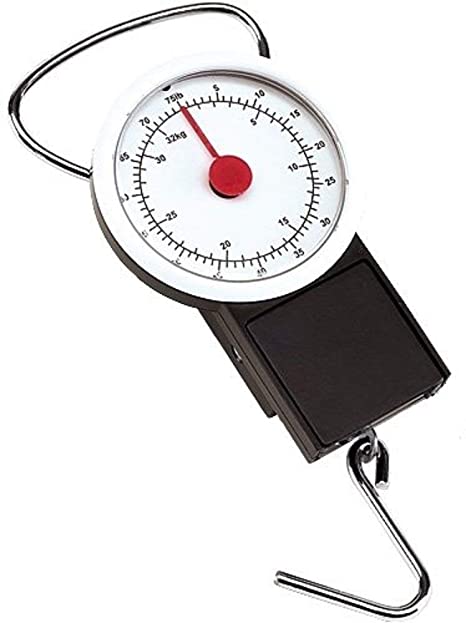
A 100kg Spring Balance is a heavy-duty mechanical weighing scale that operates on the principle of Hooke's Law (where the extension of the internal spring is proportional to the weight applied).
In 2026, these remain essential for industrial and agricultural use because they require no batteries and are virtually immune to the electronic failures that plague digital scales in wet or dusty conditions.
1. Technical Specifications
Most professional 100kg spring balances (like the Salter 235-6S or Sparex series) follow these industrial benchmarks:
|
Feature |
Standard Specifications |
|
Max Capacity |
100 kg (220 lbs) |
|
Graduation (Resolution) |
500 g (Standard) or 200 g (High-precision) |
|
Accuracy Class |
Class IIII (Industrial/General Purpose) |
|
Dial Diameter |
150 mm (6 inches) to 160 mm |
|
Housing Material |
Powder-coated mild steel or High-impact ABS |
|
Hardware |
Stainless steel top suspension ring and bottom "S" hook |
|
Tare Range |
Typically 10% to 15% (Manual zero adjustment) |
2. Top Models & Manufacturers (2026)
Salter 235-6S (The Gold Standard)
- Case: Robust ABS plastic (rust-proof) or the 235-6M (mild steel).
- Features: Shatterproof polycarbonate dial cover and low-friction bearings for a "no-jump" needle.
- Price: ~$90 – $110 (£85 – £100).
RS PRO / Pesola (Precision Series)
- Design: Often tubular or high-visibility circular dials.
- Best For: Labs and chemical plants where precision to within 5g–50g is required even at high capacities.
- Price: ~$150 – $200.
Sparex / Kerbl (Agri-Industrial)
- Design: Heavy-duty steel casings, often painted in high-visibility colors.
- Best For: Farms, calving, and weighing animal feed.
- Price: ~$20 – $70 depending on the casing material.
3. Key Advantages
- Zero Maintenance: No charging or battery swaps. It is "always ready" for use.
- Environmental Resistance: Unaffected by extreme cold ($ -20^{\circ}$C) or high humidity, which typically kills LCD screens.
- Dual Calibration: Most dials feature Kilograms in black and Pounds in red, allowing for instant reading in either unit.
- High-Contrast Reading: The large physical needle is much easier to read from a distance or in direct sunlight compared to digital displays.
4. Maintenance & Safety
- Zeroing: Always check the needle before a lift. Use the knurled nut at the top to align the needle perfectly with "0."
- Avoid "Spring Creep": Do not leave 100kg loads suspended for long periods (e.g., overnight), as this can permanently stretch the spring and lead to inaccurate readings.
- Shock Loading: Never drop a weight onto the hook. Sudden force can snap the internal rack-and-pinion gear.